
Jennifer Garvey Berger says that we often have a wish list of what people should become but we forget to acknowledge where they are currently. In the absence of that, she says that the bridge is tethered to only one end and it is hard to make the change happen. A simple but a profound insight.

Tackling self-limiting beliefs – Ricardo Sunderland speaks about how we can deal with our self-limiting beliefs that we are often blind to that can hold us back.
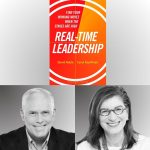
Carol and David speak about their M.O.V.E framework; M – Mindful, O – Options Generating, V – Validating the Vantage Point, E – Engage and effect change. The key, they say, borrowing from Viktor Frankl, is to create the space between stimulus and response.

David Bradford speaks about how there are three realities in any conversation between A and B. 1) A’s intent 2) A’s behaviour 3) Impact of A’s behaviour on B. A can see 1 and 2 and B can see 2 and 3. The challenge often happens when A makes up a story about 3 or B makes up a story about 1. David likens this to how we play tennis and urges us to stay on the same side of the net (2 being the metaphorical net in this case).
David Bradford speaks about how at least one of the individuals needs to take responsibility to drive the repair and restoration and rejuvenation of the relationship.
David Bradford speaks about personality (which is often hard-wired) and behaviour (often in the realm of growth and change). He speaks about how we can’t use our personality as an excuse for our behaviour.

In my experience of having worked with leaders, I have realized that outcomes often depend on the mindset of the coachee than the skill-set of the coach.

Ayelet Fishbach speaks about the link between our approach to optimizing or satisficing in a certain domain and our identity. She goes on to say that our identity often helps us prioritize across different choices and the extent to which we push ourselves in a certain domain.
Ayelet Fishbach speaks about the case of Marie Curie. She wins the Nobel Prize in 1903 with her husband Pierre Curie for discovering Radioactivity. (She wins another Nobel Prize in 1911 for isolating pure Radium). Their eldest daughter, Irene Curie, won the Nobel Prize with her husband Frederic Joliot Curie. They were the second couple to win the Nobel Prize together, the first one being Marie and Pierre. Ayelet speaks about the power of joint goals using this as a reference case in point.
Ayelet Fishbach speaks about the four steps involved in Goal setting and what it takes in getting the right balance between inspiration and action orientation of the goal. She also goes on to speak about the roles of approach goals (going towards something) and avoidance goals (moving away from something) and how we can work with the two as we move forward.
Ayelet Fishbach speaks about how we should think about “glass half full or empty” when it comes to motivating ourselves or others around us. Do we look at the ground we have traversed or the distance ahead? She speaks about the nuance involved here and when each of the approaches might make sense for us to motivate ourselves or others around us.
Ayelet Fishbach speaks about the fact that we often have celebrations at the beginning of a journey and at the end of the journey and it is the long messy middle during which we often struggle to find the motivation to keep marching forward. She shares some insights on how we can overcome this long middle.